We Need Your Support
Donations are tax deductible and you will receive a charitable tax receipt for 100% of your gift.

Support CCD's work on the Carter case: Help To Live Not Die.
Act Now
You Presence is requested at CASHRA2013.ca Early bird registration ends April 18, so register online. Read more.
Sign Up for a Voice of Our Own
A quarterly newsletter from CCD.
Rethinking Knowledge and Power: Reflections on the Disability Community in Canada (presentation)
Related Documents
June 5, 2012
Rethinking Knowledge and Power: Reflections on the Disability Community in Canada
Presentation to the Canadian Disability Studies Association/Association
Canadienne des Études sur L’Incapacité
Wilfrid Laurier University, Congress 2012
31 May 2012
Michael J. Prince
Canadian disability community
-
Comprises several arenas:
- diverse sector of service organizations
- policy community of interest groups and coalitions
- comparatively new social movement
- constitutional category of citizens under the Canadian Charter of Rights and Freedoms
- research and knowledge production network
Divergent perspectives on ability/disablement
- charitable paternalism
- spiritual humanitarianism
- practices of medical expertise
- welfare or warfare statism
- forbidden narratives
- experiential stories versus official rhetoric
- discourse on systemic oppression
Canadian State as a site of knowledge/power on disability
- Production of data and the dissemination of information
- Suppression of information sharing and of knowledge generation and contestation
- Hierarchical classification of knowledge
- Regulation of information production and circulation
- Cooptation of innovative ideas and critical discourses
The politics of knowledge production
- Numerous ways of manufacturing, managing and manoeuvring data, information and discourse
- Not so much about generating evidence in contrast to ignorance, as about multiple forms of knowledge interacting with, and struggling against each other within power relationships
- Certain ideas and information on disability are organized into public debate and policy making while other ideas and information are organized out of official politics
Future for Disability Studies
- A promising part lies in remembering the past and in recovering historical knowledge
-
Using conceptions of power and knowledge that:
- acknowledge negative and productive effects
- take into account the full range of governing mechanisms and policy instruments at play in state structures and civil institutions
- recognize continuities and disjunctures in the exercise of authority, and thus the possibilities for resistance and social change
- Connecting with disability activism
Michael J. Prince
Lansdowne Professor of Social Policy
Faculty of Human and Social Development
Disabling Poverty and Enabling Citizenship CURA http://www.ccdonline.ca/en/socialpolicy/poverty-citizenship
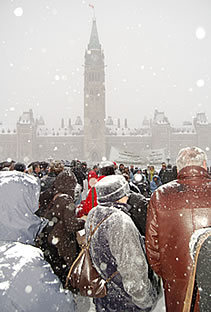
End Exclusion supporters rally in support of an accessible and inclusive Canada.